

Sperm Bank Market to Reach US$ 6.9 Billion by 2033 at 3.8% CAGR | Persistence Market Research
Sperm Bank Market
BRENFORD, LONDON, UNITED KINGDOM, July 23, 2026 /EINPresswire.com/ -- The Sperm Bank Market is witnessing consistent growth as fertility preservation, assisted reproductive technologies, and awareness regarding reproductive health continue to expand worldwide. The increasing acceptance of donor insemination, delayed parenthood, and the rising prevalence of infertility are encouraging individuals and couples to seek sperm banking services. Healthcare providers are also improving access to fertility preservation programs, creating long-term opportunities for the market. Continuous technological improvements in cryopreservation and specimen storage further strengthen the industry's outlook.
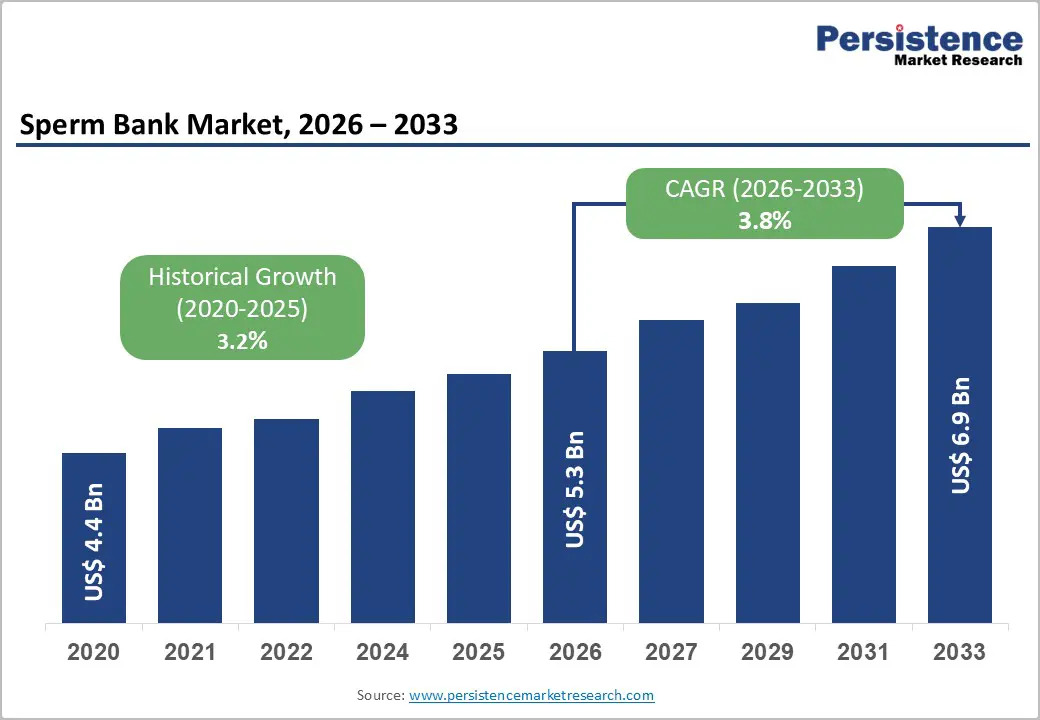
The global sperm bank market size is likely to be valued at US$ 5.3 billion in 2026 and is projected to reach US$ 6.9 billion by 2033, growing at a CAGR of 3.8% during the forecast period 2026–2033. Rising investments in fertility clinics, growing demand for reproductive healthcare, and favorable advancements in genetic screening continue to support market expansion. Donor sperm services remain the leading segment because of increasing demand from infertility treatments and single-parent or LGBTQ+ family planning. North America leads the market owing to advanced healthcare infrastructure, higher awareness, supportive regulations, and the widespread adoption of assisted reproductive technologies.
Want Market Insights? Get Your Free Report Sample : https://www.persistencemarketresearch.com/samples/5330
Key Highlights from the Report
➤ The global sperm bank market is expected to grow from US$ 5.3 billion in 2026 to US$ 6.9 billion by 2033, registering a CAGR of 3.8%.
➤ Growing adoption of assisted reproductive technologies is creating sustained demand for sperm banking services.
➤ Rising awareness regarding fertility preservation among cancer patients and delayed parenthood supports market growth.
➤ Technological advancements in cryopreservation and genetic screening are improving storage quality and treatment outcomes.
➤ Increasing acceptance of donor insemination among diverse family structures is expanding the customer base.
➤ Investments in fertility clinics and reproductive healthcare infrastructure continue to strengthen market opportunities.
Market Segmentation
The sperm bank market can be segmented based on donor type, service type, storage solutions, and end users. Donor sperm services account for the leading market share because they support fertility treatments for couples facing male infertility, single women, and same-sex couples. Storage and preservation services are also experiencing healthy demand due to the increasing preference for fertility preservation before medical treatments or delayed family planning. Advanced cryogenic storage technologies ensure long-term specimen viability while maintaining high-quality standards.
Based on end users, fertility clinics represent the dominant segment due to their growing patient volumes and expanding reproductive healthcare services. Hospitals, specialty reproductive centers, and research institutions also contribute significantly to market demand. Increasing collaborations between fertility specialists and sperm banks improve treatment accessibility while enhancing patient confidence. Digital donor databases and streamlined screening procedures further strengthen service efficiency and customer satisfaction across multiple healthcare settings.
Customize This Report for Your Exact Requirements : https://www.persistencemarketresearch.com/request-customization/5330
Regional Insights
North America continues to dominate the sperm bank market because of its established fertility treatment ecosystem, supportive healthcare policies, and high public awareness regarding reproductive health. The region also benefits from widespread access to fertility clinics, advanced laboratory technologies, and increasing acceptance of assisted reproductive procedures. Continuous investment in reproductive medicine further supports steady market expansion.
Europe represents another important regional market driven by expanding fertility services, growing infertility awareness, and technological innovation in reproductive healthcare. Meanwhile, Asia Pacific is emerging as a promising region because of improving healthcare infrastructure, rising disposable incomes, increasing medical tourism, and growing awareness of fertility preservation among younger populations seeking family planning solutions.
Market Drivers
The primary driver for the sperm bank market is the increasing prevalence of infertility worldwide, encouraging more individuals and couples to seek assisted reproductive treatments. Delayed parenthood, changing lifestyles, environmental factors, and certain medical conditions continue to influence fertility rates. These trends are boosting demand for donor sperm and long-term fertility preservation services across developed and emerging economies.
Another significant growth driver is the continuous advancement of reproductive technologies. Improved cryopreservation methods, enhanced genetic screening, better donor selection processes, and digital management systems have increased treatment success rates and patient confidence. Growing awareness campaigns regarding fertility preservation before chemotherapy and other medical treatments also contribute to the expanding adoption of sperm banking services globally.
Unlock Complete Insights – Buy the Full Report : https://www.persistencemarketresearch.com/checkout/5330
Market Restraints
Despite positive growth prospects, the sperm bank market faces several challenges. Regulatory frameworks governing donor screening, specimen storage, and cross-border reproductive services vary considerably across countries, creating operational complexities for market participants. Ethical concerns and legal issues related to donor anonymity may also limit market expansion in certain regions.
High treatment costs associated with fertility procedures remain another significant restraint. While sperm banking itself is becoming increasingly accessible, related assisted reproductive treatments can still be expensive for many individuals. Limited reimbursement policies, social stigma surrounding infertility, and unequal access to specialized fertility clinics further restrict widespread market adoption in developing regions.
Market Opportunities
Growing awareness regarding reproductive health presents substantial opportunities for market participants. Expanding educational initiatives, increasing acceptance of fertility preservation, and rising demand from individuals delaying parenthood continue to create favorable conditions for industry growth. Healthcare providers are also expanding specialized fertility centers to serve a broader patient population.
Technological innovation offers additional long-term opportunities for the sperm bank market. Artificial intelligence-assisted donor matching, advanced genetic testing, automated laboratory systems, and digital patient engagement platforms are expected to improve operational efficiency and treatment outcomes. Strategic partnerships between fertility clinics, research organizations, and reproductive healthcare providers are also likely to accelerate future market development.
Company Insights
Key players operating in the sperm bank market include:
• California Cryobank
• Fairfax Cryobank
• Cryos International
• Xytex Corporation
• Seattle Sperm Bank
• New England Cryogenic Center
• European Sperm Bank
• London Sperm Bank
• Indian Spermtech
• Androcryos
Explore the Latest Trending Research Reports:
Earwax Removal Market
Hospital Workforce Management Market
Persistence Market Research
Persistence Market Research Pvt Ltd
+1 646-878-6329
email us here
Visit us on social media:
LinkedIn
Instagram
Facebook
YouTube
X
Legal Disclaimer:
EIN Presswire provides this news content "as is" without warranty of any kind. We do not accept any responsibility or liability for the accuracy, content, images, videos, licenses, completeness, legality, or reliability of the information contained in this article. If you have any complaints or copyright issues related to this article, kindly contact the author above.
